
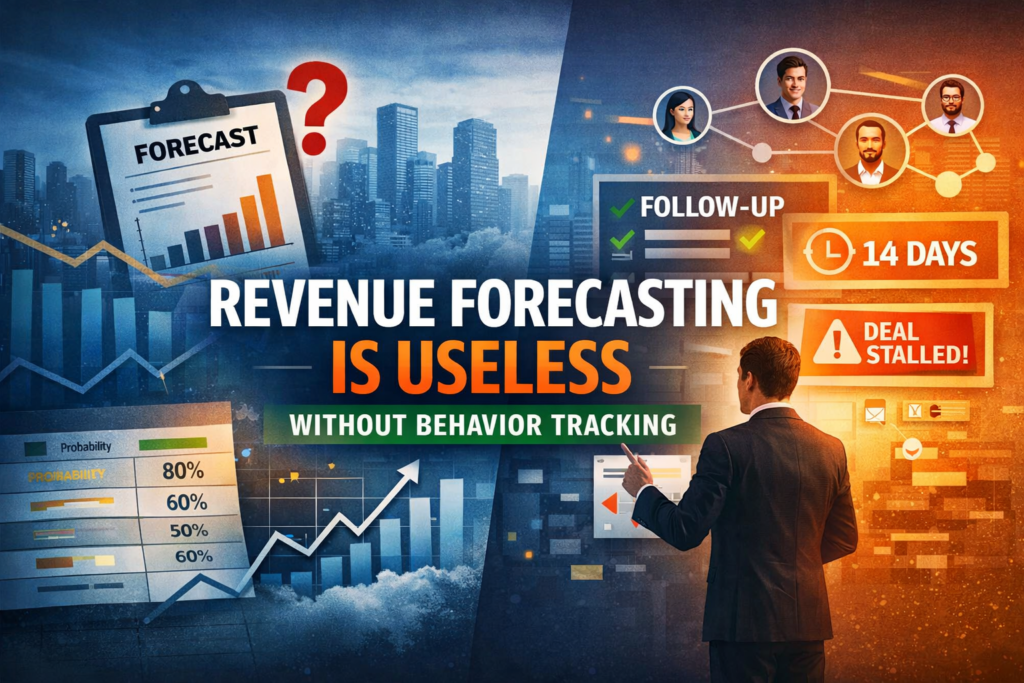
If your forecast depends on rep optimism instead of execution data, it’s already broken.
Most revenue forecasts fail for one simple reason:
They are built on numbers, not behavior.
Sales leaders spend hours debating pipeline value, probability percentages, and close dates. Spreadsheets get refined. Dashboards look impressive. Yet quarter after quarter, forecasts miss.
Not by a little.
By a lot.
The problem isn’t forecasting as a concept.
The problem is what you’re forecasting.
The Forecasting Illusion
Most sales forecasts answer questions like:
- How much pipeline do we have?
- What stage are deals in?
- What probability should we assign?
But they completely ignore the only thing that actually moves deals forward:
Sales behavior.
A deal at “80% probability” with no follow-ups in 14 days is not 80%.
It’s dead.
A deal with 5 stakeholders engaged, consistent follow-ups, and forward motion — even at “40%” — is far more real.
Yet most CRMs treat both as equal.
That’s why forecasts look confident on paper and collapse in reality.
Why Stage-Based Forecasting Fails
Stages are static.
Buying behavior is not.
When forecasts rely on stages alone:
- Reps move deals forward to look productive
- Managers accept updates instead of evidence
- Pipeline gets inflated with false confidence
Stages tell you where a deal is supposed to be.
Behavior tells you what’s actually happening.
Without behavior tracking, forecasting becomes storytelling.
What Actually Predicts Revenue
Revenue is not predicted by:
- deal size
- stage
- close date
Revenue is predicted by:
- follow-up consistency
- response velocity
- stakeholder coverage
- time spent moving vs stalling
- execution discipline per rep
These are behavioral signals.
And they’re largely invisible in traditional forecasting models.
The Missing Layer: Behavior Tracking
Behavior tracking answers questions forecasts never do:
- How long has this deal been idle?
- Are follow-ups happening on time?
- Is the rep multi-threading or single-threaded?
- Is momentum increasing or decaying?
When you track behavior, forecasting becomes factual instead of hopeful.
A deal with poor behavior patterns should be discounted automatically – no debate required.
Why Most Teams Avoid Behavior-Based Forecasting
Because it’s uncomfortable.
Behavior tracking exposes:
- lazy follow-ups
- false pipeline
- execution gaps
- uneven rep discipline
It removes the safety net of “we tried.”
But avoiding discomfort doesn’t protect revenue.
It delays reality.
How QuotaRider Approaches Forecasting Differently
QuotaRider treats forecasting as an execution outcome, not a reporting exercise.
Instead of asking reps, “How confident are you?”
The system asks, “What has actually been done?”
QuotaRider tracks:
- follow-up adherence
- deal velocity per stage
- stakeholder engagement depth
- inactivity windows
- rep execution consistency
Forecast confidence is weighted by behavioral evidence, not gut feeling.
This changes everything.
Forecasting Becomes a Control System
When behavior is tracked:
- stalled deals are flagged early
- false pipeline collapses before it hurts you
- managers coach with facts, not opinions
- leadership sees risk weeks earlier
Forecasting stops being reactive.
It becomes preventive.
The Real Role of RevOps
RevOps shouldn’t just report numbers.
RevOps should:
- define required behaviors per stage
- enforce execution standards
- remove subjectivity from forecasts
QuotaRider enables RevOps teams to control execution, not just visualize outcomes.
That’s the difference between seeing a miss and preventing one.
Why This Matters More as You Scale
Early-stage teams can survive on intuition.
Scaling teams cannot.
As headcount grows:
- execution variance increases
- pipeline noise multiplies
- forecasting accuracy drops
Behavior tracking is what keeps revenue predictable at scale.
Without it, growth amplifies chaos.
Final Thought
If your forecast depends on:
- rep confidence
- stage percentages
- end-of-quarter heroics
You’re not forecasting revenue.
You’re forecasting hope.
Real forecasting starts when behavior becomes visible, measurable, and enforceable.
That’s what QuotaRider is built for.