
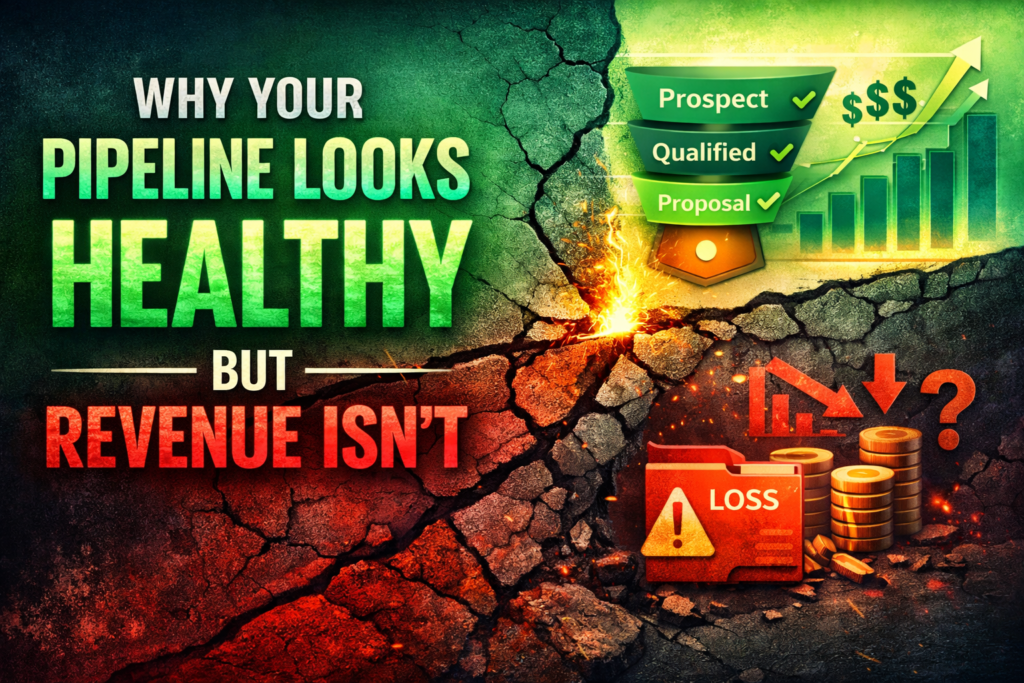
Most founders and revenue leaders have seen this pattern play out.
The pipeline dashboard looks strong.
Deals are moving.
Forecast numbers look “reasonable.”
And yet – revenue misses the target.
Again.
At this point, the usual reactions kick in:
- “Sales needs better leads”
- “We need more follow-ups”
- “Let’s hire another rep”
- “The market is slow”
But here’s the uncomfortable truth:
If your pipeline looks healthy but revenue isn’t showing up, your problem is not demand.
It’s false progress inside your sales system.
The Illusion of a Healthy Pipeline
Most sales pipelines are optimism engines, not execution systems.
Deals move stages because:
- a rep “feels good” about the conversation
- a prospect said “let’s reconnect”
- someone didn’t say no
CRMs make this worse.
They allow deals to progress based on hope, not proof.
As long as a deal has:
- a value
- a stage
- a close date
…it counts as pipeline.
But pipeline is not intent.
Pipeline is not commitment.
Pipeline is not execution.
Where Pipelines Break (Quietly)
Here’s what actually happens in most teams:
- Deals enter the pipeline with weak qualification
- Follow-ups slow down after initial interest
- Buying committees are never mapped
- Silence is misinterpreted as progress
- Stalled deals are kept alive “just in case”
By the time leadership notices a problem, the quarter is already lost.
The pipeline didn’t fail suddenly –
it failed weeks ago, silently.
The Core Issue: Pipelines Track Stages, Not Behavior
Traditional pipelines answer:
- “What stage is this deal in?”
They do not answer:
- “What action is happening right now?”
- “Is the buyer actually engaging?”
- “Is this deal moving forward or just aging?”
This is the fundamental flaw.
Revenue is driven by behavior:
- response speed
- follow-up quality
- stakeholder engagement
- momentum between steps
If your system doesn’t track and enforce these behaviors, your pipeline will always lie.
Why More Leads Don’t Fix This
Many teams respond by increasing lead flow.
More inbound.
More outbound.
More campaigns.
This only makes the problem worse.
Why?
Because you’re feeding more leads into a system that:
- doesn’t enforce action
- doesn’t detect stalling
- doesn’t punish inactivity
You don’t need a bigger pipeline.
You need a truer one.
What a “Real” Pipeline Looks Like
A real pipeline is not based on stages alone.
It is based on validated movement.
That means:
- Deals can’t move forward without evidence
- Silence reduces confidence automatically
- Stalled deals are surfaced early
- Optimism is replaced by signals
In a real pipeline:
- confidence is earned
- progress is proven
- forecasts are grounded in behavior
This is where most CRMs stop – and where execution platforms begin.
How QuotaRider Approaches Pipeline Truth
At QuotaRider, we look at pipelines differently.
We don’t ask:
“What stage is this deal in?”
We ask:
“What has actually happened – and what must happen next?”
Instead of trusting manual updates, the system looks for:
- real engagement
- follow-up discipline
- time-based decay
- stakeholder coverage
Deals that stop moving don’t hide.
They surface.
Forecasts aren’t built on rep confidence –
they’re built on execution signals.
The Real Fix Isn’t Better Reporting
Most companies try to solve this with:
- more dashboards
- more reports
- more weekly reviews
But reporting looks backward.
Revenue problems need forward-looking control.
That control comes from systems that:
- enforce behavior
- expose friction early
- make inactivity visible
When execution becomes unavoidable, revenue becomes predictable.
Final Thought
If your pipeline looks healthy but revenue isn’t showing up, don’t ask:
“What’s wrong with the market?”
Ask this instead:
“Where is our system allowing false progress?”
Because until your pipeline reflects truth instead of hope, revenue will always be a surprise.
And surprises don’t scale.