
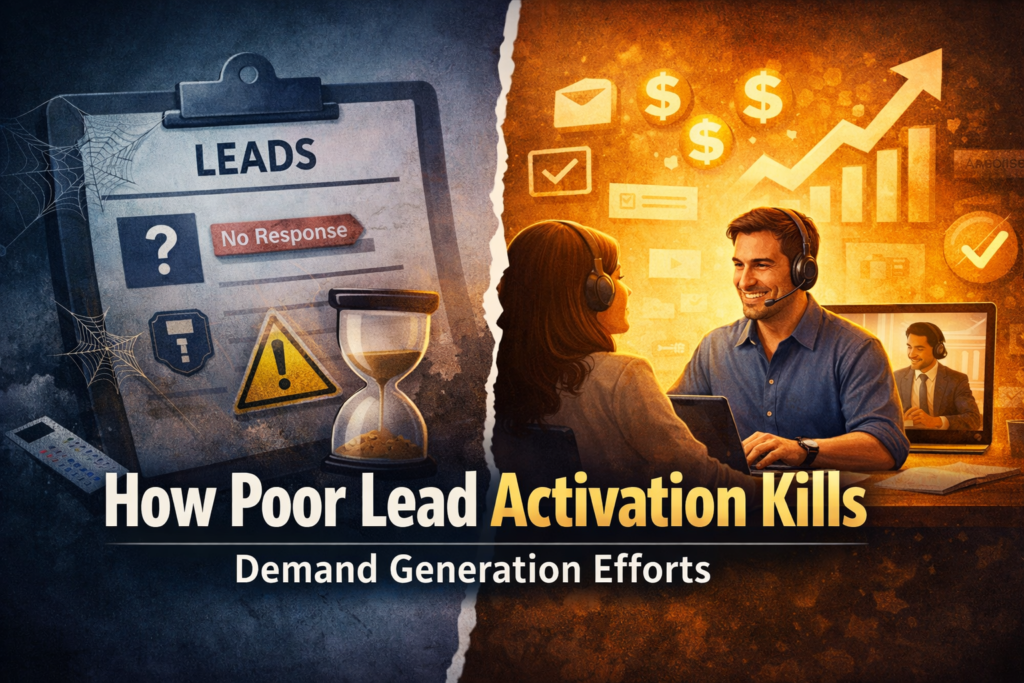
Most demand generation teams think their job ends at lead creation.
Traffic is coming in.
Forms are filling up.
Campaign dashboards look healthy.
And yet-revenue doesn’t move.
The problem isn’t demand generation.
The problem is what happens immediately after a lead enters your system.
That moment-often ignored, often unmanaged-is where most revenue quietly dies.
Demand Generation Fails After the Lead Arrives
Demand generation doesn’t fail because of poor targeting or weak messaging.
It fails because leads are:
- captured
- stored
- and then… left idle
In most organizations:
- Leads enter a CRM
- Status changes to “New”
- And nothing systemic happens next
Sales teams are expected to “pick it up” when they can.
That gap-between lead arrival and first meaningful action—is the single most expensive blind spot in modern GTM systems.
Lead Activation Is Not Follow-Up
Most teams confuse lead activation with follow-up.
They are not the same.
- Follow-up is communication
- Activation is system behavior
Lead activation answers one question:
“What must happen immediately to convert intent into momentum?”
Without a defined activation mechanism, every lead-no matter how good-starts decaying the moment it enters your CRM.
The Hidden Cost of Idle Leads
Here’s what poor lead activation actually causes:
1. Intent Decay
Leads don’t lose interest slowly-they drop off sharply.
If the first action doesn’t happen fast and with context, urgency disappears.
Marketing assumes sales didn’t care.
Sales assumes marketing sent bad leads.
Both are wrong.
The system failed.
2. False Demand Signals
Marketing dashboards still look strong:
- CPL is stable
- Traffic is growing
- Conversion rates haven’t collapsed
But pipeline quality quietly deteriorates.
Demand generation appears “working” while revenue stalls.
This is how companies over-invest in marketing while underperforming on revenue.
3. SDRs Default to Convenience
When activation is manual:
- Reps prioritize familiar accounts
- New leads wait
- High-intent leads compete with low-intent noise
Not because reps are lazy-but because the system gives them no priority signal.
Why CRMs Don’t Solve Lead Activation
CRMs are designed to store leads, not activate them.
They track:
- fields
- stages
- ownership
They do not:
- enforce first actions
- create urgency
- block inactivity
So companies add:
- reminders
- Slack pings
- SOP documents
None of these create discipline.
They create dependency on human memory.
Lead Activation Is a System Responsibility
If lead activation depends on:
- reps remembering
- managers checking
- playbooks being followed
It will fail at scale.
A real activation system does three things automatically:
- Forces the first action
- Every new lead creates a mandatory next step
- No silent lead states
- Measures speed, not intention
- Time-to-first-action is visible
- Delays are flagged, not ignored
- Creates momentum, not tasks
- The system decides what happens next
- Reps execute instead of choosing
Without these, demand generation becomes a volume game with diminishing returns.
Where Most Teams Get This Wrong
Teams try to fix activation by:
- buying more tools
- adding automations
- writing better SOPs
But activation isn’t about automation volume.
It’s about behavior enforcement.
If a lead can enter your system and sit untouched for hours—or days—you don’t have demand generation.
You have lead collection.
How QuotaRider Thinks About Lead Activation
At QuotaRider, lead activation is treated as a core revenue control, not a sales task.
The belief is simple:
Demand generation only works if lead activation is unavoidable.
That means:
- No lead enters without an enforced first action
- No rep decides whether to act-only how
- No pipeline exists without movement pressure
Activation is not optional behavior.
It’s system-driven execution.
Demand Generation Is Only as Strong as Its Activation Layer
Marketing creates interest.
Sales converts interest.
But activation connects the two.
When activation breaks:
- demand stalls
- pipeline lies
- revenue becomes unpredictable
Fixing activation doesn’t require more leads.
It requires a system that turns intent into action-immediately and consistently.
Final Thought
If your demand generation feels expensive, inconsistent, or disconnected from revenue, don’t look at your campaigns first.
Look at what happens in the first hour after a lead arrives.
That’s where growth is either accelerated-or quietly killed.

Hi, this is a comment.
To get started with moderating, editing, and deleting comments, please visit the Comments screen in the dashboard.
Commenter avatars come from Gravatar.